
Technique
PVC Film Alimentaire vs PE Film Alimentaire: Which Should You Importer in 2026?
PVC Film Alimentaire vs PE Film Alimentaire: Which Should You Importer in 2026?
For most of the last two decades the choice between PVC film alimentaire and PE film alimentaire was simple: PVC for fresh-counter wrap and price-sensitive HORECA, PE for microwave-safe consumer packs. In 2026 that picture has shifted. EU regulation is tightening around PVC plasticisers, PE grades have improved, and many B2B importerateurs now carry both materials side by side. This guide compares the two films on the ten dimensions that actually matter to buyers — performance, food safety, regulation, cost, and use-case fit — and ends with a market-by-market recommendation.
The short answer (for people who skim)
| Dimension | PVC film alimentaire | PE film alimentaire |
|---|---|---|
| Material | Polyvinyl chloride + qualite alimentaire plasticiser | Polyethylene (LDPE / LLDPE) |
| Cling / self-adhesion | Excellent — industry benchmark | Moderate; often tackified |
| Transparency | Crystal clear, high gloss | Clear, slightly hazier |
| Stretchability | Moderate | High |
| Heat resistance | Up to ~60°C short contact | Up to ~100°C, microwave-safe |
| Freezer use | OK down to –20°C | OK down to –40°C |
| Plasticiser | Yes (qualite alimentaire) | None |
| EU regulatory status | Under restriction pressure (REACH, ECHA) | Accepted |
| Cost (factory gate) | Baseline | +10–25% |
| Dominant use cases | Supermarche fresh counter, HORECA | Microwave packs, EU own-label, freezer |
If you are sourcing for Southeast Asia, the Middle East, Egypt, Africa, India, Central/South America or the CIS, PVC is still the workhorse. If you are sourcing for the EU, the UK or parts of Oceania, the market has largely moved to PE and you should follow it.
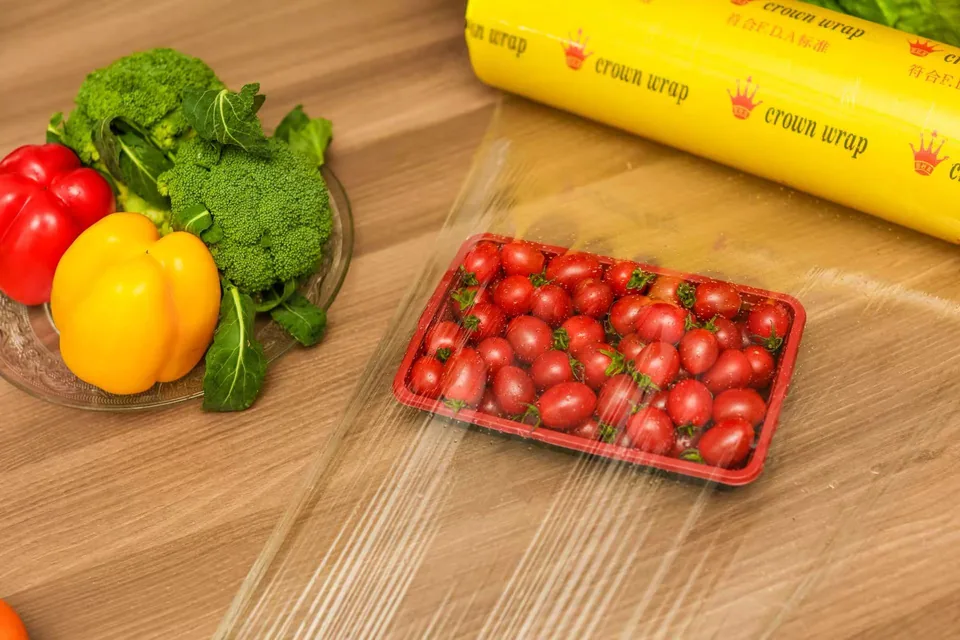
Material composition
PVC film alimentaire is made from polyvinyl chloride resin plasticised with qualite alimentaire additives — typically DEHA, DOA, polymeric plasticisers or newer non-phthalate chemistries. The plasticiser is what makes the film flexible and sticky; without it, PVC is a rigid plastic. The grades used in food-contact film are distinct from construction PVC and are tested against specific migration limits. For a step-by-step look at how these formulations are extruded, see our manufacturing process article.
PE film alimentaire is made from polyethylene — usually LDPE (low-density polyethylene), LLDPE (linear low-density polyethylene), or a blend. Self-cling is weaker than PVC, so many PE film alimentaires include a small amount of tackifier (polyisobutylene / PIB) to improve adhesion on trays and on itself.
The practical consequence: PVC’s flexibility and cling come from the plasticiser; PE’s come from the polymer structure itself. That is why the EU’s regulatory attention is directed at PVC (specifically, at certain plasticisers) rather than at the polymer.
Performance — the properties buyers actually care about
Cling and self-adhesion
PVC wins decisively. Food-grade PVC film alimentaire grips trays, glass, ceramic and itself without heat or adhesive — a property supermarche wrap stations rely on for speed. Standard PE needs tackifier to approach PVC’s cling, and even then it is rarely as strong. A supermarche operator switching from PVC to PE typically reports more re-wrapping, more film per tray and slower throughput at the counter.
Transparency and gloss
PVC has higher clarity and a glossier surface, which makes fresh meat, seafood and produce look brighter under retail lighting. For fresh-counter use this translates directly into purchase conversion. PE is clear but slightly hazier, especially at higher epaisseures.
Stretchability
PE stretches further before breakage than PVC. This matters less for food-contact film than for industrial film etirable industriel (pallet wrap, which is a different product — see our film etirable vs film alimentaire vs film etirable industriel guide), but for hand-wrap of irregular shapes PE is slightly more forgiving.
Heat resistance
PE is better. Standard PE film alimentaire is rated for microwave reheating up to around 100°C for short periods. PVC film alimentaire is rated for short contact up to around 60°C and should not be microwaved — plasticiser migration into hot, fatty food is a recognised concern.
Freezer use
Both work in a chiller and a domestic freezer. PE has a slight edge at very low temperatures (down to about –40°C), which matters for exporter of frozen seafood and meat.
Food safety and regulation
United States / FDA
Both materials are accepted for food contact under FDA 21 CFR. PVC food-contact formulations fall under 21 CFR 177.1950 and related sections; PE films fall under 21 CFR 177.1520. Compliant factories in both categories routinely ship to US importerateurs.
European Union
This is where the picture shifts.
- The European Chemicals Agency (ECHA) has restricted several phthalate and non-phthalate PVC plasticisers under REACH.
- A broader PVC restriction proposal has been under formal assessment by ECHA, covering microplastic release, additive migration and end-of-life concerns.
- Many major EU retailers have voluntarily switched own-label film alimentaire to PE on sustainability grounds — our marque privee guide covers comment set up an own-label film alimentaire programme with a Chinese fournisseur.
- PVC film alimentaire is not outright banned at the time of writing, but the direction of travel is clear, and buyers importering into the EU increasingly specify PE.
A recent industry survey suggested more than half of global fabricants have begun transitioning some or all of their food-film output toward PE or alternative polymers — Berry Global, Klöckner Pentaplast and other international brands have all launched PE-based replacements for traditional PVC film alimentaire.
Other markets
- Southeast Asia, Middle East, Egypt, Africa, India, Latin America, CIS: PVC food-contact film is accepted. Local regulation typically mirrors either FDA or a generic food-contact framework, and retailers and HORECA continue to use PVC as the default for fresh counters.
- Japan, Korea, Taiwan: PVC is accepted and widely used in the fresh-food channel, with tight migration-testing regimes. PE is common for consumer home-use packs.
- China: No domestic ban on PVC food-contact film. PVC still represents 60–70% of the Chinese cling-film market by volume.
Cost
PVC resin sits around RMB 6,000/tonne in 2026; LDPE/LLDPE runs RMB 7,500–9,000/tonne. PVC also processes on simpler casting lines with fewer converter steps. Combined, that gives PVC film alimentaire a 10–25% cost advantage per equivalent roll at the factory gate against PE film alimentaire. For a deeper cost breakdown, see our 2026 film alimentaire price guide.
At factory FOB level in 2026, typical ranges:
| Product | PVC FOB (USD/tonne) | PE FOB (USD/tonne) |
|---|---|---|
| Jumbo roll, qualite alimentaire | ~$1,400–1,800 | ~$1,700–2,200 |
| HORECA finished roll | ~$1,800–2,300 | ~$2,100–2,700 |
| Retail consumer pack | varies by packaging | varies by packaging |
Gaps widen further at retail level because PE’s premium also gets marked up.
Use-case fit — who should use what
PVC is the right choice for:
- Supermarche fresh-food wrap stations — meat, seafood, poultry, produce trays. Cling, transparency and cost dominate.
- HORECA — hotel and restaurant kitchen storage, banquet service. Cling and price matter; microwave does not.
- Food processors — in-line tray-wrap on automatic machines that are calibrated to PVC’s stretch and cling profile.
- Price-sensitive retail — general-trade consumer packs in markets where PVC is accepted and cost matters.
- Exporter to markets without PVC restrictions — Southeast Asia, Middle East, Egypt, Africa, India, Latin America.
PE is the right choice for:
- Microwave consumer packs — household film alimentaire sold for reheating.
- EU and UK own-label retail — where retailers have specified PE.
- Frozen food wrap — long-term freezer storage.
- Plasticiser-free specifications — certain baby food, dairy and organic-label brands.
- Exporter to markets phasing out PVC — EU, UK, parts of Oceania, some North American chains.
Which should you importer? A market-by-market recommendation
| Market | Recommended primary | Notes |
|---|---|---|
| Philippines, Indonesia, Malaysia, Vietnam, Thailand | PVC | No restriction, strong supermarche + HORECA demand, price-sensitive |
| UAE, Saudi Arabia, Qatar, Kuwait | PVC | Hotel and restauration dominate demand; PVC remains standard |
| Egypt | PVC | Strong importer demand, no PVC restriction, limited local PVC capacity |
| Nigeria, South Africa, Kenya | PVC | Cold-chain and retail still building; PVC is the price-leader |
| India | PVC, with PE for premium SKUs | Large price-sensitive base; PE for urban premium retail |
| Latin America | PVC | Broadly similar to Southeast Asia; follow retailer spec |
| China (domestic) | PVC | 60–70% market share, no domestic ban |
| EU, UK | PE | Regulatory and retailer preference both point to PE |
| United States | PVC or PE | Both accepted; follow buyer / retailer spec (see US procurement guide) |
| Japan, Korea | PVC for fresh counter; PE for consumer | Mature split by channel |
Practical sourcing recommendation
For most B2B importerateurs outside the EU, the right 2026 answer is: primary volume in PVC film alimentaire, with a PE SKU added if any part of your distribution touches the EU, microwave retail, or frozen-food processors. Choose a fournisseur that can produce both under one roof — this avoids the complexity of managing two factories, two sets of documentation and two shipping lanes for what your customer sees as one product line. Jumbo-format buyers can mix both materials in a single container; see our film alimentaire rouleau jumbo page for container-load economics.
SUNWRAP has produced qualite alimentaire PVC film alimentaire for 20+ years under Korean investment, and added PE film alimentaire to our Ningbo Cixi lines in 2025 as part of a RMB 400 million relocation and capacity expansion. Both products are produced to FDA food-contact standards and SGS-tested, 40 km from Ningbo-Zhoushan Port. If you are deciding between PVC and PE for a specific market or SKU, contact our exporter team and we will help you match the material to the use case.
Frequently asked questions
Is PE film alimentaire safer than PVC film alimentaire? Both are food-safe when made to spec and used as intended. PE is plasticiser-free and preferred for microwave and freezer. PVC outperforms PE on cling, transparency and cost.
Can I microwave PVC film alimentaire? We do not recommend it. Use PE for microwave reheating.
Why do supermarches still use PVC instead of PE? Cling, transparency and cost — all of which matter more at a fresh-food counter than microwave performance.
Is PVC film alimentaire banned in the EU? Not banned outright, but under REACH and ECHA restriction pressure, and many EU retailers have voluntarily moved to PE.
Which is cheaper? PVC, by 10–25% at the factory gate in 2026.
Can one factory supply both? Yes, a well-equipped factory can run both lines — increasingly the preferred setup for B2B importerateurs.
Frequently Asked Questions
Is PE film alimentaire safer than PVC film alimentaire?+
Both are food-safe when manufactured to spec and used as intended. PE (polyethylene) contains no plasticisers and is the preferred material for microwave reheating and freezer storage. PVC uses qualite alimentaire plasticisers and outperforms PE in cling, transparency and supermarche fresh-counter use. Regulatory attention on PVC plasticisers in the EU has pushed some European buyers toward PE, but for most non-EU markets PVC remains fully acceptable when produced by a compliant [film alimentaire fabricant](/).
Can I microwave PVC film alimentaire?+
We do not recommend microwaving any PVC film alimentaire. The PVC structure can soften and plasticiser migration into oily, hot food becomes a concern. For microwave reheating and high-temperature applications, use PE film alimentaire, which is more heat-stable and plasticiser-free.
Why do supermarches still use PVC film alimentaire instead of PE?+
Three reasons: PVC has much stronger self-cling (it grips trays and itself without heat), higher transparency and gloss (fresh meat and produce look brighter), and a lower cost per roll. These properties matter more at a fresh-food counter than microwave performance, which is why PVC still dominates supermarche wrap stations even where PE is widely available.
Is PVC film alimentaire banned in the EU?+
Not banned outright, but under regulatory pressure. The European Chemicals Agency (ECHA) has restricted several PVC plasticisers, and the broader PVC restriction proposal under REACH is progressing. Many EU retailers have voluntarily switched to PE for own-label film alimentaire. For most non-EU markets — including Southeast Asia, the Middle East, Egypt, Africa, India and the Americas — PVC remains fully legal.
Which is cheaper, PVC or PE film alimentaire?+
PVC is typically 10–25% cheaper per equivalent roll at the factory gate. PVC resin runs around RMB 6,000/tonne versus LDPE/LLDPE at RMB 7,500–9,000/tonne in 2026, and PVC processes on simpler casting lines. The price gap is the main reason price-sensitive HORECA and retail buyers in Asia and the Middle East still prefer PVC.
Can a factory supply both PVC and PE film alimentaire?+
A well-equipped factory can, but the extrusion lines are different (PVC uses calendering or casting; PE uses blown or cast PE). Buyers increasingly look for fournisseurs who can offer both, so they can run PVC for fresh-counter/HORECA lines and PE for microwave/EU-bound SKUs without adding a second fournisseur.
Vous approvisionnez du film alimentaire et avez des questions?
Articles connexes
Film Alimentaire Price Guide 2026: PVC, PE, Jumbo & Retail Roll Costs
Cling film price guide 2026 — resin costs, factory margins, FOB vs CIF ranges by SKU, and a line-by-line read of a Chinese fournisseur's quotation, for PVC and PE.
Film Etirable vs Film Alimentaire vs Stretch Film: What's the Difference?
Cling wrap, film alimentaire, film etirable industriel — a B2B terminology guide explaining which word means what in which market, so your next RFQ uses the correct term.