
Food Safety
Can You Sous Vide With Cling Film? FDA/EU Rules
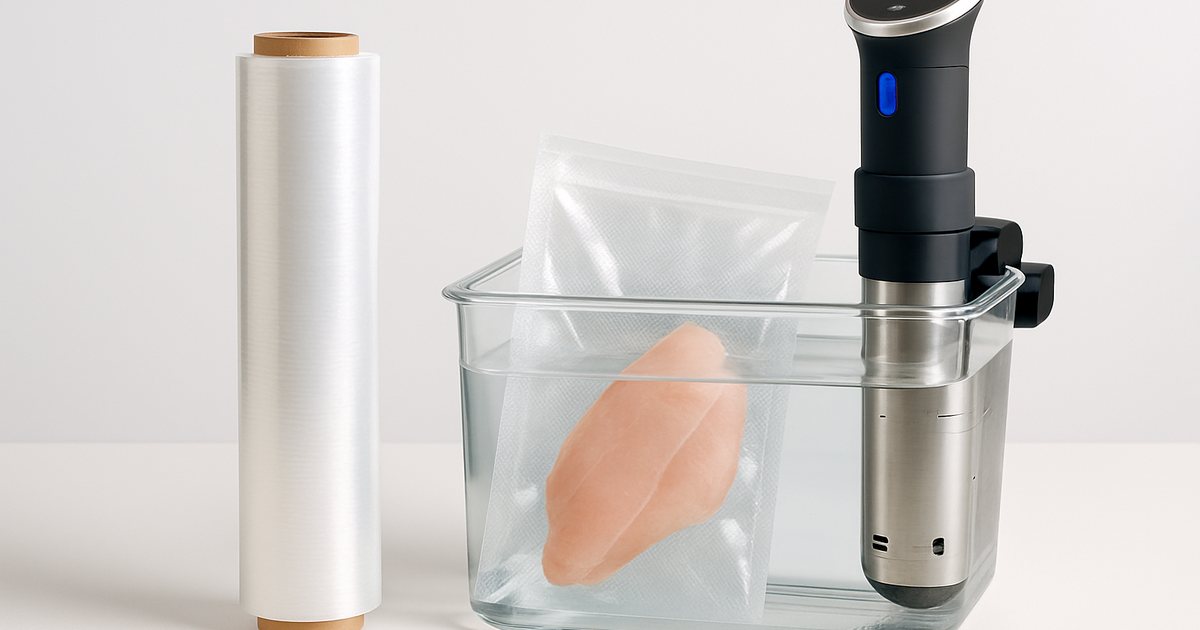
Quick answer: No — not for an actual sous vide cook. Sous vide’s defining feature is hours of sealed contact between film and warm food, usually 54-85°C for anywhere from 45 minutes to 72 hours. Neither the US FDA’s eight conditions of use nor the EU’s migration-test tiers were built around that exposure. FDA gives plasticized PVC food film no heated clearance at all on fatty food. The EU’s heating formula only switches on at 70°C, and even then it runs out at 15-120 minutes — a fraction of a typical sous vide cook. PE cling film has a real “for cooking” clearance in the US, but it’s an identity approval, not a time-and-temperature one, so it doesn’t tell you anything about a six-hour bath either. Use a bag built for the job.
We make the PVC and PE film this question keeps coming back to at Ningbo Sanrong New Materials, and we get asked some version of “can our customer use your film for sous vide” a few times a year from foodservice distributors testing a new use case before they print it on a box. Here is the regulatory answer, not the marketing one.
Why This Question Exists: Sous Vide Doesn’t Look Like Any Cling Film Use Case
Every use case cling film clearances were written for has a short exposure window: wrap a chiller tray, cover a bowl for the freezer, vent-cover a plate in the microwave for two minutes. Sous vide inverts all three assumptions at once — it is warm (not chilled or frozen), sealed (not vented), and long (not brief). A few reference points from common sous vide guides:
| Food | Typical bath temperature | Typical hold time |
|---|---|---|
| Thin fish fillet | 50-60°C | 30-45 minutes |
| Eggs (soft-set) | 63-75°C | 45-75 minutes |
| Steak, 1-2 inch | 54-60°C | 1-4 hours |
| Chicken breast | 60-65°C | 1-4 hours |
| Root vegetables | 83-85°C | 1-2 hours |
| Short rib, brisket, pork shoulder | 55-65°C | 24-72 hours |
That spread — 50 to 85°C, 30 minutes to three days — is the whole problem in one table. It straddles the boundary of every test tier built for cling film, and on the long end it exceeds all of them by a wide margin. The rest of this guide walks through why, using the same FDA and EU frameworks we cite for every other temperature question we get, applied here for the first time.
The FDA Side: Eight Conditions of Use, None of Them “Simmer for Six Hours”
US rules don’t give food-contact plastics a temperature rating. They clear a substance for specific conditions of use, listed in Table 2 of 21 CFR 176.170(c):
| Condition | FDA description | Does a sous vide bath fit? |
|---|---|---|
| A | High-temperature heat-sterilized (over 100°C) | No — too hot, and this is a manufacturing/retort condition, not a home water bath |
| B | Boiling-water sterilized | No |
| C | Hot filled or pasteurized above 66°C | No — describes filling a container with hot product, not immersing a sealed pack in heat for hours afterward |
| D | Hot filled or pasteurized below 66°C | No, same reason |
| E | Room-temperature filled and stored | No |
| F | Refrigerated storage, no thermal treatment | No |
| G | Frozen storage, no thermal treatment | No |
| H | Frozen/refrigerated ready-meals reheated in the container | Closest on paper, but written for a short microwave or oven reheat, not a multi-hour bath |
None of the eight is “sealed pack held at 55-85°C for one to seventy-two hours.” That’s not an oversight — the list describes packaging-line thermal history (how a product was filled and stored before sale), not an in-kitchen cooking method. Sous vide simply post-dates the use cases this table was written to cover.
Layer the material-specific clearances on top, and PVC comes out worse than PE:
- 21 CFR 178.3740 clears the plasticizer used in PVC food film (DEHA) on fatty foods only under conditions F and G — refrigerated and frozen storage. There is no heated condition on that list at all for fatty food. Since most sous vide proteins (meat, poultry, fish, eggs, dairy) are fatty enough to trigger this restriction, PVC cling film has zero FDA heated clearance for them, regardless of how long or short the bath runs. (Non-fatty vegetables technically sit outside that specific restriction — but PVC’s thinner gauge and higher cling still make it a poor practical choice for water immersion.)
- 21 CFR 177.1520, item 2.2 clears polyethylene “used for packing or holding food during cooking,” with a tighter hexane-extractables limit (2.6%) than general-use PE (5.5%). This is a real, food-cooking-specific clearance — but it’s an identity approval. It doesn’t specify a maximum temperature or duration the way the EU rule below does, so it can’t tell you whether one hour or three days at 60°C is inside or outside what the resin was qualified for.
If you’re speccing a private-label box: neither of these gives you a defensible “sous vide safe” claim to print. F/G-only means PVC is out on fatty food, full stop. PE’s cooking clearance is real but open-ended on time and temperature, which is not the same as tested-and-cleared for a specific bath profile.
Selling into foodservice and getting asked about sous vide? Tell us the food type, bath temperature and hold time your customer wants to run, and we’ll tell you honestly whether any claim is supportable — or whether they need a different product entirely. Ask our technical team →
The EU Side: A Formula That Runs Out Exactly Where Sous Vide Begins
The EU takes a different approach under Regulation (EU) No 10/2011 (consolidated text, 16 March 2025): no fixed rating, just a migration test matched to the worst realistic time and temperature of use. Annex V sets standard test tiers, and the heating tiers only start at 70°C:
| Test | Test condition | Maximum real-use heating time this supports |
|---|---|---|
| OM1 | 10 days at 20°C | Frozen and refrigerated contact — not a heating clearance |
| OM2 / OM3 | Up to 2h at 70°C | 120 minutes at 70°C, falling by half every 10°C: 60 min at 80°C, 30 min at 90°C, 15 min at 100°C |
| OM4 / OM5 | 1-2h at 100-121°C | High-temperature use, still capped in hours not days |
Run the numbers against the sous vide table above and the gap is stark:
- Vegetables at 83-85°C for 1-2 hours land squarely in the 70-100°C heating band. Interpolating the formula (t = 120 / 2^((T−70)/10)) gives roughly 40-45 minutes of covered contact time at 85°C — a typical 1-2 hour vegetable cook already runs 1.5-3x past that ceiling.
- Steak, chicken and eggs at 54-75°C for 1-4 hours fall below the 70°C floor where the heating formula even applies. That doesn’t make them safe by default — it means the EU framework has no heating tier for this band at all. It’s warmer and longer than OM1 (cold storage) assumes, but never reaches the 70°C threshold where OM2/OM3 kick in. A 3-hour bath at 60°C sits in a genuine blind spot between the two test families, not inside either one’s coverage.
- Tough cuts at 55-65°C for 24-72 hours are the most extreme case on the table: three days of continuous contact against a formula whose longest heating tier tops out at two hours.
No standard cling film test — Japanese labelling ratings, FDA conditions, or EU migration tiers — was built with a “warm for days” use case in mind, because until sous vide became a mainstream cooking method, nothing wrapped in cling film sat at those temperatures for that long. Our temperature range guide works through this same FDA/EU framework for hot-holding and microwave use; sous vide is simply the most extreme duration case we’ve mapped against it.
Where the “85°C” Number Circulating Online Comes From
Search for cling film and sous vide and you’ll find a specific figure repeated across cooking forums and a handful of packaging blogs: cling film is “food-safe up to 85°C (185°F)” for sous vide use. We looked for the source behind that number and could not find a stated test method, a food type, or a duration attached to it anywhere it appears.
That pattern is familiar. Our temperature range guide found the same thing with the 60°C and 130°C figures that circulate for general cling film heat resistance — real numbers, from real tests, quoted without the method that makes them meaningful. 85°C is a plausible figure for when a film starts to soften or feel tacky under light mechanical load — not a food-contact migration clearance, and not a number tied to any duration. A softening point and a safe-contact-time are two different measurements, and only one of them is regulated. We would not print an unsourced number like that on a box, and we wouldn’t build a cooking recommendation on one either.
PVC vs PE vs a Real Sous Vide Pouch
| Retail PVC cling film | Retail PE cling film | Dedicated sous vide / retort pouch | |
|---|---|---|---|
| Heated clearance for fatty food (US) | None (fatty food restricted to conditions F/G only) | Yes, identity-based (21 CFR 177.1520 cooking grade), no stated duration limit | Typically qualified against high-temperature/retort-style conditions specific to the resin and construction |
| EU heating tier typically tested | Not usually tested past ambient/cold tiers | Sometimes tested to OM2/OM3 (up to 2h, 70-100°C) | Often validated to higher OM tiers for sustained near-boiling use |
| Seal type | None — cling only, not a true seal | None — cling only, not a true seal | Heat-sealed or zip-locked, genuine water barrier |
| Typical resin | Plasticized PVC | LDPE / LLDPE | PA/PE laminate or retort-grade PP, construction varies by supplier |
| Verdict for a multi-hour bath | Not cleared, don’t use | Not cleared for this duration, don’t rely on it | Built and tested for this use — use it |
The practical takeaway for a distributor or private-label brand: cling film and sous vide pouches are different products solving different problems, not two thicknesses of the same film. Our PVC vs PE comparison guide covers where each material is the right call — sustained water immersion isn’t one of the columns either wins.
The One Case Where Cling Film Legitimately Shows Up Near a Sous Vide Setup
There’s a narrow, genuinely low-risk use that gets confused with “sous vide in cling film”: a brief reheat of an already-cooked, already vacuum-sealed meal, loosely covered with PE cling film at 50°C or below for under 30 minutes to keep splatter down — not a raw or partially-cooked food held at temperature for hours. That’s closer to the vented-microwave-reheat use case our temperature guide already covers, just at a lower bath temperature instead of a microwave. It is not the same claim as “safe for sous vide cooking,” and the two get run together constantly in cooking-forum advice.
If your customers are foodservice operators asking about this specific short-reheat scenario, it’s worth spelling out the distinction on the box or in your sell sheet — “for brief reheating of pre-cooked, sealed portions only, not for raw cooking” is a defensible instruction; “sous vide safe” as a blanket claim is not.
If You Want to Develop a Film Actually Rated for This
We get this request often enough to have a standard answer: it’s possible, but it isn’t a relabeling exercise. A film genuinely qualified for multi-hour water-bath contact would need, at minimum, a resin and additive package selected for thermal and hydrolytic stability at the target temperature, a true heat-seal (not cling-only closure), and migration testing run at the actual bath temperature and hold time rather than a standard retail tier. That’s a different product development project from our standard PVC and PE lines, closer to what retort pouch converters run. If a customer wants to pursue it, tell us the target temperature range, maximum hold time and food category, and we can scope what testing and construction it would take — and whether it makes more sense to source a purpose-built pouch instead.
Related Guides
- Cling Film Temperature Range: Freezer to Microwave
- Cling Film Plasticizers: DEHA vs ATBC Limits
- PVC Cling Film vs PE Cling Wrap: Complete Comparison for B2B Buyers
- What Is Saran Wrap Made Of? PVDC Changed to LDPE in 2004
- HORECA Cling Film Guide for Restaurants and Caterers
- PE Cling Film: Specifications and Formats
- PVC Cling Film: Specifications and Formats
Get a Straight Answer Before You Print a Claim
Send us the food type, bath temperature and hold time your customer has in mind, and we’ll tell you plainly whether standard PVC or PE film supports any claim at all, or whether the application calls for a different product. We’d rather lose an order than have our film’s name on a box making a promise the regulation doesn’t back up.
Need a cling film quote while you're reading?
Our export team responds within 12 hours with FOB Ningbo pricing. No obligation.
Frequently Asked Questions
Can you sous vide with cling film or plastic wrap?+
Not for a real sous vide cook. Cling film clearances in both the US and EU were written around retail and foodservice conditions — chiller, freezer, brief hot-fill, or vented microwave reheat — and none of them cover hours of sealed contact with warm food in a water bath. FDA gives DEHA-plasticized PVC film no heated condition of use at all on fatty food, and the EU's heating-duration formula only starts at 70°C and runs out at 15-120 minutes, far short of a typical 1-72 hour sous vide cook. Use a dedicated sous vide pouch or a bag rated for the purpose; don't substitute cling film.
Is Saran Wrap safe for sous vide?+
Modern Saran Wrap is polyethylene (SC Johnson reformulated it away from PVDC in 2004), which has a real regulatory basis for heat contact under 21 CFR 177.1520's cooking-grade entry — but that clearance is an identity-based approval, not a time-and-temperature clearance the way the EU's is. It doesn't state a duration limit the way EU Regulation 10/2011 does, and a multi-hour water-bath immersion is a different exposure than anything the resin was tested against for retail sale. Treat any consumer cling film, including Saran Wrap, as unproven for sustained sous vide immersion rather than cleared for it.
What temperature does cling film start to leach into food?+
There is no single leaching temperature — migration is a function of time and temperature together, which is exactly what the EU's OM0-OM7 test tiers measure. PVC food film is roughly a quarter to a third plasticizer by weight, and plasticizer migration into fatty food accelerates with both heat and contact time. At sous vide temperatures (54-85°C) held for hours, both variables are higher than any standard migration test for cling film was designed to check, which is why we recommend a dedicated pouch rather than relying on a wrap that was cleared for chiller or brief hot-fill use. Our plasticizer guide covers the DEHA and ATBC migration limits in detail.
Why do some sites say cling film is safe for sous vide up to 85°C?+
We could not find a test method, food type or duration behind that figure in any source that cites it — the same pattern our temperature range guide found for the 60°C and 130°C numbers that circulate for general cling film heat resistance. 85°C is a plausible softening-point figure for some films under a light mechanical load, not a food-contact migration clearance. A number without a stated test method and duration is not something we would rely on for a multi-hour water-bath application, and it is not something we would print on a box.
What's the difference between a sous vide bag and cling film?+
Different resin, different clearance basis, different test. Dedicated sous vide and retort-style pouches are typically laminates (commonly polyamide/polyethylene or polypropylene-based) engineered and validated for sustained near-boiling immersion, closer to the FDA's high-temperature conditions of use and the EU's higher OM4/OM5/OM7 test tiers. Retail cling film — PVC or PE — is formulated and cleared for wrapping, not for hours of submerged cooking, and manufacturers don't submit it for that kind of testing because it isn't the product's intended use.
Can I use cling film to double-wrap food inside a proper sous vide bag?+
This is the one place cling film shows up safely in a sous vide kitchen: as an inner liner for delicate items (a whole fish, a custard) inside a bag that provides the actual seal and water barrier, at moderate temperatures and for cook times under a few hours. It is not a substitute for the outer pouch, and it should not be relied on to hold a food-safe seal by itself. If you are a foodservice brand wanting to formalize this in a spec sheet, tell us the temperature and hold time and we'll tell you what claim, if any, you can support.
Sourcing cling film and have questions this article didn't answer?
Related articles
Cling Film Plasticizers: DEHA vs ATBC Limits 2026
DEHA's EU limit is 18 mg/kg, but the 60 mg/kg total-plasticizer cap is what fails films. Factory guide to DEHA vs ATBC, EU 10/2011 and FDA rules. Get a quote →
Cling Film Temperature Range: Freezer to Microwave
Japanese boxes rate PVC wrap to 130 °C, yet FDA clears DEHA film on fatty food only chilled or frozen. Freezer & microwave limits explained. Get a quote →
HoReCa Cling Film: Restaurant & Catering
Complete guide for HORECA buyers sourcing cling film: 300m catering rolls, food service wrap specifications, dispenser compatibility, bulk pricing for restaurants/hotels/catering, and industrial-grade cling for commercial kitchens.